


OYO: Hotel Booking App
PRISM: Hotels, Homes & Experiences in 35 Countries
When I need a room quickly and do not want to spend a long evening comparing hotel websites, I look for an app that makes the basic decision easy: where can I stay, what will it cost, and can I book it without unnecessary friction? OYO: Hotel Booking App is built around that practical problem. It belongs to the Travel & Local category, is free to download, and focuses on hotel rooms, budget lodges, homes, and airport motel searches in many destinations.
My impression is that OYO works best as a fast accommodation-search tool rather than as a complete travel planner. It can be useful for a last-minute overnight stay, a short business trip, or a simple room search in an unfamiliar city. At the same time, I would not treat every listing as automatically interchangeable. The final choice still depends on the property, its location, the room details, and how carefully I read the booking conditions before paying.
How I Decide Whether OYO Is the Right Booking App
The first thing I consider is the kind of trip I am arranging. If I want a reasonably priced room and I am flexible about the exact property, OYO has an obvious appeal. If I am planning a special holiday, need a very specific hotel standard, or want a broad comparison across every possible accommodation provider, I may prefer a larger general travel marketplace or the hotel’s own booking channel.
OYO is especially easy to understand when the search starts with a clear practical limit. I can enter a destination, choose dates, and use the visible room options to narrow the decision. The store summary emphasizes nearby budget lodging and hotel rooms, with starting prices shown in US dollars, as well as airport motels. That positioning tells me what the app is trying to solve: finding a place to sleep without beginning with luxury features or complicated itinerary building.
I also look at the quality of the information before I commit. A low displayed price is only useful if the room type, location, included services, and booking terms make sense for my trip. My habit is to compare the total shown at the final stage with the initial search result, then check the property name and address again. This small pause matters more than simply choosing the cheapest card on the screen.
Latest News

Uber Eats Under Pressure: What Happens When Delivery Goes Wrong

How QR & Barcode Scanner Adapts to Android and iOS Innovations

Why Waze Navigation & Live Traffic Is Your Essential Travel Companion

CapCut Mastery: Unleash Hidden Features for Pro-Level Editing

How OS Updates Enhance Roblox Adventures

Teacher Simulator: Exam Time Turns Quick Classroom Judgments into a Repetitive Loop
A realistic last-minute travel scenario
Imagine arriving in a city after a delayed journey and discovering that continuing home is no longer convenient. I would open OYO, search near my current area or near the airport, and focus first on distance and availability rather than on attractive photographs. For that situation, the app’s value is speed: it gives me a focused place to begin instead of making me search through unrelated holiday rentals, resorts, and long-stay apartments.
I would then check whether the selected property is practical at that hour. A room that looks inexpensive but is far from the airport may become less attractive once transportation and time are considered. This is one of the less obvious trade-offs with any budget accommodation app: the cheapest room is not always the cheapest or safest overall decision for a short overnight stop.
For a planned weekend, I use a different process. I search several nearby areas rather than entering only the most famous neighborhood. This can reveal whether staying one transport stop away gives me better value. OYO is more useful in that situation when I treat it as a map-based discovery tool and not merely as a list where the first result is automatically the best one.
Gallery
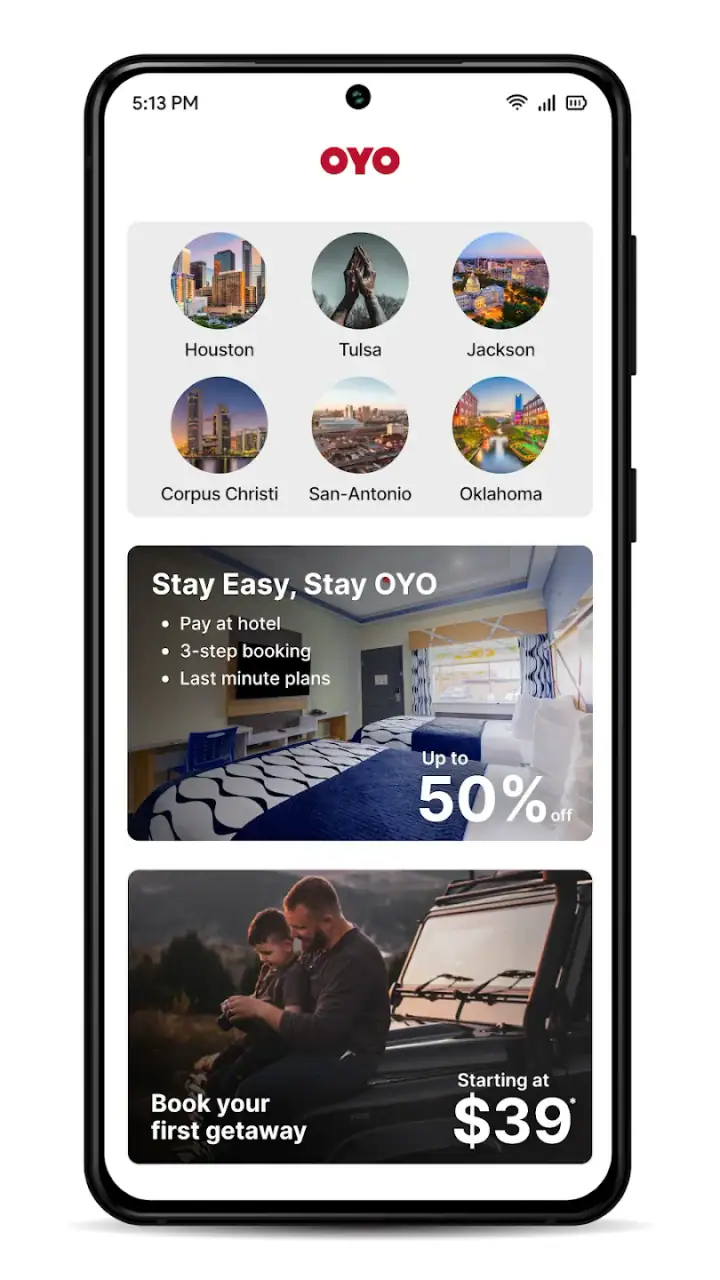
What makes the app convenient in everyday use
The free price removes an easy barrier to trying it. I can install it, browse rooms, and decide whether its coverage suits my destination before making a booking. The app is rated for Everyone, which also makes its general presentation approachable for ordinary travelers rather than only frequent business users.
Its scale is another reason I take it seriously. OYO has passed one hundred million installs and holds a 4.6 average from around two million ratings. Those figures do not guarantee that every individual stay will be perfect, but they suggest that the app is familiar to a large number of travelers and has received substantial ongoing use.
The developer is listed as PRISM: Hotels, Homes & Experiences in 35 Countries. That identity matches the app’s broader accommodation focus: I am not looking only at traditional hotels, but at a mix that can include homes and other room-oriented stays. The range is useful when I am open to different types of accommodation, although it also means I need to read each listing instead of assuming that every result offers the same experience.
Three practical habits that improve the search
My first useful habit is to search twice: once for the exact destination and once for nearby areas. A city-center search can hide reasonable options just outside the busiest zone, while a broad search can make the map look attractive but leave me with an inconvenient commute. Comparing both views helps me decide whether saving money is worth the extra travel.
My second habit is to inspect the room details after finding a promising property, not before. Budget listings often look similar in a quick scroll, but the meaningful differences can be the room category, occupancy, included facilities, and cancellation wording. I do not rely on the headline price alone. The booking screen deserves the same attention as the search screen.
My third habit is to save the property address and booking details where I can reach them quickly. If I am arriving late, I do not want to depend on remembering the hotel name from a crowded search result. I also check the route from the airport, station, or meeting location before finalizing the booking. This is particularly important when the app presents airport motels alongside ordinary city hotels.
Where OYO has the clearest advantage
OYO wins for travelers who value a short path from “I need a room” to “I have a shortlist.” Its focus is narrower than a full travel super-app, and that can be an advantage. I am not forced to begin with flights, attractions, restaurant reservations, or a large collection of unrelated travel products.
It is also a good fit for people who are comfortable making a sensible compromise. I may accept a simpler room, a less central location, or a less familiar property in exchange for a lower-cost stay. For a one-night stop, that trade can be completely reasonable. For a longer trip, I become more demanding because small inconveniences repeat every day.
The airport-motel angle is useful for a particular kind of traveler: someone dealing with an early departure, a late arrival, or a long connection. In that case, proximity can matter more than sightseeing access. I would still verify the actual route and practical arrival details, but the category itself makes the search more relevant than a general hotel list would be.
The app’s current version is 12.5.3, and it supports devices running Android 7.0 or later. That makes it accessible to people who do not own a recent phone. I appreciate that because travel apps are often needed when someone is using an older backup device or has limited access to newer hardware.
Where other booking options may fit better
I would look beyond OYO when I need a highly consistent hotel experience across several nights. A direct hotel booking channel may be better for a traveler who already knows the property, wants to manage an existing loyalty relationship, or prefers dealing with the accommodation provider from the start. I would also compare directly when the hotel’s own cancellation or room information is especially important to me.
A broad accommodation marketplace may suit me better when I want to compare hotels, apartments, hostels, guesthouses, and unusual stays in one large search. OYO can cover hotels, homes, and experiences, but its strongest identity remains practical room booking. If the trip depends on a kitchen, a particular apartment layout, a long stay, or a distinctive property type, I would not assume that a budget-hotel-focused search is enough.
Maps and ordinary web searches can also be better for checking the surroundings. I use OYO to find possible rooms, but I may use a map to inspect the distance to a conference venue, transport stop, or airport. This is not a criticism of the app; it is simply a reminder that accommodation quality includes the neighborhood and route, not just the room card.
Another limitation is that a low starting price can shape expectations too strongly. The amount displayed in a search is a useful invitation to investigate, not a complete reason to book. Dates, room choices, taxes, fees, and property-specific terms can affect the final decision. I always continue through the booking flow far enough to understand the actual commitment before treating the result as a bargain.
What to check before confirming a room
I begin with the exact dates and number of guests, then check whether the selected room matches those details. Next, I look at the address rather than relying only on the destination label. Two properties described as being in the same city can be very different for airport access, public transport, or a morning appointment.
I also read the cancellation and payment wording slowly. A flexible plan may be worth more than a slightly cheaper non-flexible one if my schedule is uncertain. Conversely, a fixed plan can make sense when my dates are certain and the saving is meaningful. The right choice depends on how likely my plans are to change, not simply on which button shows the smaller amount.
For a late arrival, I pay attention to any information about arrival timing and contact details shown during booking. I do not want to discover after landing that a property is inconvenient for my arrival hour. If the listing leaves me unsure about a basic practical matter, I choose a clearer option rather than hoping the problem will resolve itself.
I would also take screenshots or keep the confirmation accessible before traveling. This is a simple backup for moments when mobile reception is poor or when I need to show the reservation quickly. It does not add much effort, and it avoids turning a small technical problem into a stressful arrival.
The cost of switching from another booking method
Moving to OYO is easy if I normally search manually and only need a room. I can install the free app, run a destination search, and compare its results with the options I already know. The real switching cost is not money; it is learning where the important information appears and developing the discipline to compare the final terms rather than the first price.
If I already use a favorite hotel chain’s own app, switching may offer less value. I could gain access to different properties, but I might lose the familiarity of a direct relationship or a booking history in one place. I would test OYO on a simple, low-risk overnight stay before depending on it for an important family trip or a complicated itinerary.
Travelers who regularly book through a broad marketplace may also find the change worthwhile only in specific situations. OYO can be a useful second search, especially for budget rooms or airport-area accommodation, but I would not delete every other option immediately. Keeping two approaches gives me a way to compare location, room type, and final cost without assuming that one catalog always has the best answer.
There is also a mental switching cost for people who prefer complete certainty. OYO’s strength is choice within a practical accommodation focus, but choice still requires judgment. I need to distinguish a genuinely convenient room from one that is merely cheap, and I need to read the property-level information carefully. Travelers who want a tightly standardized experience may find that process tiring.
Who should use it, and who should skip it?
I recommend trying OYO if you often need affordable hotel rooms, make short trips, travel through airports, or want a quick alternative to searching each property individually. It is particularly suitable when you can be flexible about the exact hotel and are willing to spend a few minutes checking the address and booking conditions.
I would be more cautious about recommending it as the only tool for a honeymoon, a large family gathering, an accessibility-sensitive stay, or a trip where the room must meet very specific requirements. In those cases, I would compare the property directly with other sources and confirm the details that matter most before paying.
I would also skip it for now if I dislike comparing individual listings or if the lowest possible price is not important to me. A direct hotel channel may feel simpler when I already know where I want to stay. Likewise, a broader travel service may be more convenient when accommodation is only one part of a larger booking plan.
My final recommendation
After using it as a practical accommodation finder, I see OYO as a useful first stop for budget-conscious hotel searches, especially when location and speed matter more than luxury or elaborate trip planning. The free app, broad adoption, Everyone age rating, and support for Android 7.0 and later make it easy to try on a wide range of devices.
Its best quality is focus. I can open it with a clear need, search for a nearby room, and build a shortlist without starting from an overwhelming travel dashboard. Its main weakness is the same thing in reverse: a focused budget search does not remove the need to inspect property details, compare nearby alternatives, and understand the final booking terms.
My advice is to use OYO as a decision tool rather than a promise that the first inexpensive result is the right one. Search nearby areas, check the route, read the room and cancellation information, and compare the final commitment with a direct hotel option when the stay matters. For a simple overnight room or an airport stop, I would gladly keep it available. For a highly specific or high-stakes trip, I would use it alongside another source instead of relying on it alone.
In short, I recommend giving it a try if your priority is finding a practical room without paying for the app itself. Just remember that the strongest booking decision comes from combining OYO’s convenient search with your own careful check of location, room suitability, and terms.
FAQs for OYO: Hotel Booking App
What is OYO: Hotel Booking App?
OYO is a popular hotel booking app that allows users to search and book accommodations quickly and easily. It offers a wide range of hotels and stays across different price ranges and locations, making it convenient for travelers looking for budget-friendly or luxurious options. The app provides features such as easy booking, secure payments, and exclusive discounts.
How do I create an account on the OYO app?
Creating an account on OYO is straightforward. Once you download the app, you can sign up using your email address or phone number. You will be asked to fill in some basic personal information and create a password. Alternatively, you can sign in using your Google or Facebook account for a faster setup.
What payment methods does OYO accept?
OYO offers multiple payment options for the convenience of its users. You can pay for your bookings using credit or debit cards, net banking, and popular digital wallets. Some locations also offer the option to pay at the hotel. All transactions are secured with robust encryption to ensure safety.
Can I cancel or modify my booking on OYO?
Yes, OYO allows you to cancel or modify your bookings directly through the app. You can view your booking details in the 'My Bookings' section and choose to cancel or make changes if needed. However, it's important to check the cancellation policy of your specific booking, as some may have non-refundable conditions.
What should I do if I face issues with my OYO booking?
If you encounter any issues with your OYO booking, you can contact their customer support for assistance. The app provides a 24/7 helpline, chat support, and email assistance to resolve any problems or queries you might have. Make sure to have your booking details handy for a quicker resolution.
Pros
- User-friendly interface with intuitive navigation.
- Wide variety of hotel options globally.
- Attractive discounts and deals available.
- Quick booking and easy cancellation process.
- 24/7 customer support for assistance.
Cons
- Occasional app crashes during peak times.
- Limited payment options in some regions.
- Inconsistent hotel quality across locations.
- Frequent notifications can be intrusive.
- Some features require a stable internet connection.


